


Caretta Friends
Every summer loggerhead turtles come ashore on the beaches of Gazipaşa to lay eggs. Someone has to walk those beaches and make sure the nests survive until the hatchlings reach the water.
Two halves, on purpose:
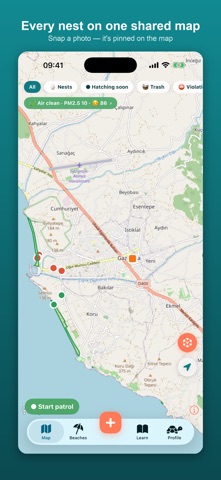
The app — iOS and Android — is for the people doing the walking. A map of the nests with the ones about to hatch marked, a log of kilometres and patrols, a record of what was found: a clutch, rubbish, a violation. Free, and usable on any beach where loggerheads nest, not only ours.
The site — carettafriends.com, in Russian, Turkish and English — answers the question a tourist actually has: I found a turtle, or a nest, or someone is disturbing one, and I do not know what to do.
That split is the whole design. The site is for the person who has thirty seconds and a problem; the app is for the person who comes back every week.
Species and nesting background
Context for the app and the site, condensed from an AI-assisted desk report (Sep 2025) built on Russian-language encyclopedia and travel pages. It is general background, not a field survey. Species facts here are textbook-level; for anything quoted in the app or on the site, check the primary literature (IUCN assessment, peer-reviewed nesting studies) first.
- Species. Caretta caretta, the loggerhead (Russian: логгерхед, каретта), family Cheloniidae. Large head and strong beak; adults can pass a metre of shell length.
- Range. Tropical and subtropical seas, including the Mediterranean, the Atlantic and parts of the Pacific and Indian oceans. Juveniles live in open ocean, adults feed over coastal shelves.
- Nesting. Females come ashore at night on sandy beaches, dig a nest in warm sand and lay from tens to over a hundred eggs, then return to the sea. Well-known Mediterranean sites in the report: Dalyan and İztuzu in Turkey, Zakynthos in Greece. Gazipaşa is not covered by the report.
- Season. Warm months; the exact window varies by region (check local data before printing dates).
- Incubation. Sand temperature shapes embryo development and the sex ratio of hatchlings, which makes beach temperature a conservation variable as the climate warms.
- Threats. Loss and degradation of nesting beaches, artificial light, poaching, fishing bycatch and pollution. Responses in the report: beach patrols, seasonal access limits, visitor education. That is the job the app’s patrol log and the site’s “found a nest” guide serve.
Source note: the underlying report cites Wikipedia (ru), cherepahi.ru and hotel or travel sites.